Patients researching LASIK in Utah increasingly encounter two distinct categories: custom procedures that map the individual optical profile of each eye, and standard procedures that apply a uniform correction based on a glasses prescription alone.
How Do Custom LASIK Procedures in Utah Differ from Standard LASIK?
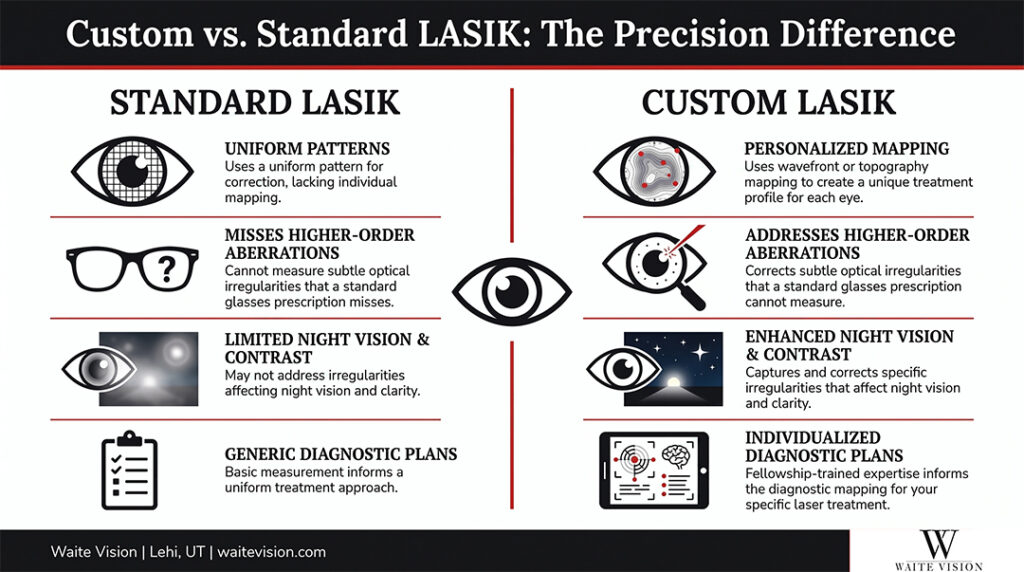
Custom LASIK in Utah uses wavefront or topography mapping to create a treatment profile unique to each eye, measuring optical imperfections beyond a standard glasses prescription. Standard LASIK corrects only basic refractive error (nearsightedness, farsightedness, and astigmatism) using a uniform ablation pattern. The distinction is clinically meaningful. Custom procedures capture and correct higher-order aberrations, subtle optical irregularities that affect night vision, contrast sensitivity, and overall visual clarity, during the laser treatment itself.
At Waite Vision in Utah, I perform both wavefront-guided and topography-guided LASIK. My fellowship training in cornea, external disease, and refractive surgery at the University of Colorado School of Medicine, along with WCRS fellowship certification, informs the diagnostic mapping process I use to design each patient’s individualized treatment plan.
Who Benefits Most from Custom LASIK vs. Standard LASIK in Utah?
Patients with higher-order aberrations, large pupils, or complex prescriptions benefit most from custom LASIK in Utah. Custom wavefront mapping detects optical irregularities that a standard refraction cannot measure, allowing the laser to target imperfections that affect night vision, contrast sensitivity, and visual sharpness. Straightforward low myopia is the exception. Patients with no measurable higher-order aberrations may achieve similar outcomes with either approach, though custom mapping still provides a more precise diagnostic baseline.
At Waite Vision, every LASIK candidate in Utah receives custom wavefront and topography mapping during their evaluation, before any procedure decision is made. This diagnostic-first approach identifies who will benefit most from custom correction and ensures no candidate proceeds without a complete picture of their individual optical profile.
What Results Can Utah Patients Expect from Custom vs. Standard LASIK?
Clinical studies show custom wavefront-guided LASIK produces measurably sharper vision with fewer visual disturbances than standard LASIK. Patients treated with wavefront-guided technology report reduced glare, halos, and night vision disturbances compared to standard correction. Precision explains the gap. The wavefront-guided approach maps each eye with substantially greater accuracy than a standard refraction, correcting optical irregularities that affect post-operative visual quality. As of 2026, this outcomes advantage is documented in peer-reviewed refractive surgery literature.
At Waite Vision, I track every patient’s visual outcomes after custom LASIK to ensure results align with the precision standards expected from wavefront-guided correction. My fellowship training in cornea, external disease, and refractive surgery at the University of Colorado School of Medicine included focused work on outcomes analysis and treatment refinement.
What Is Wavefront-Guided LASIK and How Does It Work for Utah Patients?
Wavefront-guided LASIK uses a wavefront aberrometer, a diagnostic instrument that maps how light travels through the entire optical system of the eye, to create a three-dimensional treatment profile. This map captures higher-order aberrations, optical imperfections beyond basic refractive error that a standard refraction does not fully measure. The laser then reshapes the cornea with a customized ablation pattern tailored to each eye’s specific measurements, rather than a uniform correction.
At Waite Vision in Utah, I incorporate wavefront aberrometry into every custom LASIK evaluation. The diagnostic mapping process goes beyond a standard glasses prescription to identify the specific optical profile of each eye, which directly informs the customized treatment plan I design for each patient.
Get started, book now.
What Is the Difference Between Wavefront-Guided and Topography-Guided LASIK in Utah?
Wavefront-guided LASIK maps how light travels through the entire optical system of the eye, including the cornea and internal lens. Topography-guided LASIK maps only the corneal surface with high-resolution detail. Wavefront-guided correction addresses both corneal and internal optical aberrations, while topography-guided correction targets corneal irregularities with greater surface-level precision. Utah practices offering both technologies can match the appropriate approach to each patient’s specific diagnostic profile.
At Waite Vision, I offer both wavefront-guided and topography-guided LASIK in Utah, selecting the approach based on each patient’s diagnostic results. Having both technologies available means I can match the treatment to each eye’s specific needs rather than applying a one-size-fits-all correction. [Platform names for each: confirm with Waite Vision]
Does Custom LASIK Cost More Than Standard LASIK in Utah?
Custom LASIK in Utah typically costs more than standard LASIK eye surgery due to advanced diagnostic mapping and specialized laser programming. As of 2026, Utah LASIK pricing varies by practice, technology used, and the complexity of each patient’s correction. The additional cost reflects the wavefront or topography-guided diagnostic process and the individualized ablation profile, not simply a premium label. Many Utah practices include custom mapping in standard LASIK pricing rather than offering it as a separate upgrade.
A coporate owned LASIK center like LASIK Plus, who is At Waite Vision, custom wavefront and topography mapping is included in every LASIK evaluation in Utah, so patients receive the most complete diagnostic picture available before any procedure decision is made. [Confirm with Waite Vision: Is mapping included in standard pricing or offered as an upgrade?]
Do Utah LASIK Practices Offer Blade-Free LASIK Options?
Most Utah LASIK practices offering custom procedures now use all-laser, blade-free technology for flap creation. Blade-free LASIK uses a femtosecond laser to create the corneal flap instead of a mechanical microkeratome blade. The femtosecond laser produces a more precise and uniform flap with predictable thickness, which contributes to the overall accuracy of custom wavefront-guided correction. As of 2026, blade-free femtosecond technology is widely available across Utah refractive surgery practices.
At Waite Vision in Utah, I use femtosecond laser technology for every LASIK flap. No mechanical blades. My fellowship training in cornea, external disease, and refractive surgery at the University of Colorado School of Medicine included extensive work with femtosecond flap creation, and the all-laser approach is foundational to the custom precision philosophy I’ve built at Waite Vision. [Femtosecond platform: confirm with Waite Vision]
Do Utah LASIK Practices Offer Custom Wavefront LASIK?
Custom wavefront LASIK is available at multiple Utah practices, including specialty refractive surgery centers in the Salt Lake City, Lehi, and Utah Valley areas. Not all Utah LASIK providers offer wavefront-guided or topography-guided options; some use only standard correction profiles. Patients seeking custom LASIK in Utah should confirm that their chosen practice uses wavefront aberrometry or topography-guided mapping as part of the treatment planning process.
Waite Vision in Lehi, Utah offers custom wavefront-guided and topography-guided LASIK with fellowship-level expertise. Dr. Aaron Waite is board certified by the American Board of Ophthalmology, holds WCRS fellowship certification, and completed fellowship training in cornea, external disease, and refractive surgery at the University of Colorado School of Medicine.
Key Takeaways: Custom LASIK vs. Standard LASIK in Utah
- Custom LASIK uses wavefront or topography mapping to correct higher-order aberrations that standard LASIK cannot address, producing improved contrast sensitivity and reduced glare and halos for most patients.
- Patients with large pupils, complex prescriptions, or measurable higher-order aberrations benefit most from custom LASIK correction at Utah refractive surgery practices.
- Both wavefront-guided and topography-guided LASIK are available at Utah specialty practices; the appropriate technology depends on each patient’s individual diagnostic results.
- Custom LASIK in Utah typically costs more than standard LASIK due to advanced diagnostic mapping and individualized laser programming rather than a uniform correction profile.
Schedule a custom LASIK evaluation at Waite Vision in Utah to find out whether wavefront-guided or topography-guided correction is right for your eyes.
Medically Reviewed By:
Aaron Waite, MD
Board-Certified Ophthalmologist
Fellowship-Trained Refractive Surgeon, WCRS
Last reviewed August 7, 2026
source https://www.waitevision.com/lasik-utah/how-do-custom-lasik-procedures-in-utah-differ-from-standard-lasik/

0 件のコメント:
コメントを投稿